In this article
Your agent brings in a landlord, markets the property, finds a tenant, and completes the letting. The immediate assignment is complete.
But how much does the company know about the relationship it has just established?
Does the landlord need someone to manage the property? Do they own other units? Are those units managed elsewhere, self-managed, or likely to become available for letting or sale?
When brokerage and property management operate in disconnected systems, these questions can fall between the teams. The cost extends beyond duplicate administration: an existing customer relationship may never become an opportunity for additional business.
A successful letting should trigger the next conversation
The agent’s responsibility may be to secure a tenant, and completing that transaction is a valid outcome. If property-management referrals sit outside the agent’s workflow, however, there may be no clear prompt, handover, or incentive to explore them.
The landlord receives their tenant. The agent moves to the next enquiry. The property-management team may never learn that a relevant conversation was available.
A more connected process gives the agent a simple way to ask whether the landlord needs ongoing support, record the interest, and pass it to the right team. The receiving team accepts the referral, follows up, and records the outcome.
One listing may be part of a larger portfolio
A brokerage may know a landlord through a single listing while having little visibility into their other properties.
Successfully finding a tenant creates a natural moment to explore that wider relationship. The agent has delivered a result and has a relevant reason to ask: “Do you have other properties you would like help managing or letting?”
The landlord may own additional units, have an upcoming vacancy, or be considering selling a property. They may manage their portfolio themselves and welcome a discussion about the support available.
These are possibilities to explore, rather than assumptions to make. A relevant conversation can reveal:
- A property-management requirement for the unit just let.
- Additional units that could come under management.
- Future rental or sale listings.
- Upcoming expiries or availability worth following up.
Record the properties and needs the landlord chooses to share, along with timing and an agreed next action. That turns a useful conversation into a relationship the company can develop over time.
Customer 360: understand the relationship before making the offer
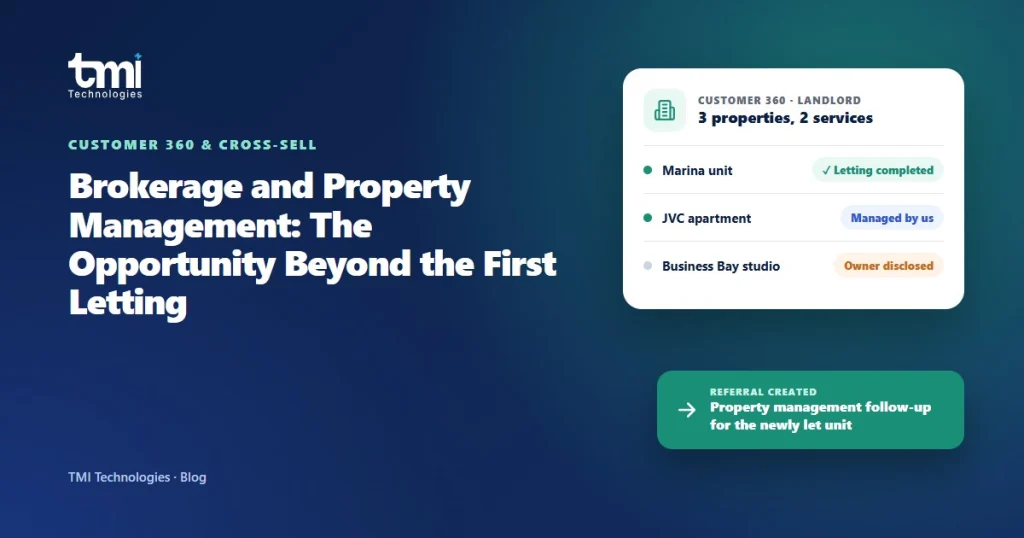
An agent should be able to understand whether the customer is a landlord using brokerage services only, an existing property-management customer, or someone using both services.
With appropriate access permissions, a shared customer view can bring together:
- Properties listed, let, sold, or currently managed by the company.
- How long each property has been under management.
- Relevant tenancy dates, renewals, and service history.
- The responsible agent and property manager.
- Existing referrals, open opportunities, and previous discussions.
- Other properties disclosed by the landlord, clearly distinguished from units already managed by the company.
This context improves the conversation. An agent can recognise an established management relationship, avoid repeating an offer already being handled, and explore whether the landlord needs help with another unit.
For example, knowing that the company has managed one property for several years gives the agent a useful starting point when discussing a newly available property. Knowing that a referral is already in progress prevents another team from approaching the landlord independently.
Customer 360 works when information is current and relevant to the user’s role. A shared view should respect access controls for sensitive financial and service information.
Make referrals visible—and recognise the agent’s contribution
An agent who introduces property-management business has contributed beyond the original letting. That contribution should remain visible through the handover.
The process should record who introduced the opportunity, who accepted it, whether it converted, and any referral commission payable under company policy.
Where agents earn across brokerage and property management, a consolidated commission view can show the source transaction, calculation basis, approved amount, and payout status. Different earning types can retain their own rules while appearing in one understandable statement.
This reduces the need for agents to chase separate teams to understand what they have earned. It also gives management a fuller picture of the people generating additional business.
Recognition need not always mean a commission payment. Clear referral attribution, targets, and performance reporting can make cross-team contribution visible even where the company uses another incentive model.
Give management a view of the whole relationship
Separate reports may show a successful letting in one department and a new management instruction in another, without connecting them to the originating agent or landlord relationship.
A connected view can help management assess:
- How many brokerage customers are referred to property management.
- Whether referrals are accepted and followed up promptly.
- Which referrals become management instructions and how many units they bring.
- Which agents generate business across service lines.
- Brokerage revenue, property-management fees, and the associated commissions.
One-time brokerage revenue and recurring property-management fees should remain distinct. Referral attribution should recognise an agent’s contribution without counting the same company revenue twice.
The everyday overhead of disconnected systems
The commercial opportunity sits alongside familiar operational challenges:
| Area | Potential impact |
|---|---|
| Customer records | Duplicate profiles, inconsistent contact details, and incomplete relationship history. |
| Documents | Repeated requests, separate copies, and uncertainty about what is complete or current. |
| Training and adoption | Different screens, terminology, and processes for staff working across teams. |
| Support and change | Multiple vendors, separate release cycles, and integration maintenance. |
| Reporting and commissions | Manual consolidation, reconciliation, and enquiries about calculations or payouts. |
| Cost | Licences, administration, support, and integration costs that need to be assessed together. |
Two systems do not automatically create these problems. Well-integrated platforms can support a connected journey. Equally, putting both departments on one platform will not resolve unclear ownership or inconsistent data by itself.
The objective is a reliable customer record, a tracked handover, clear responsibilities, and reporting that connects the work across teams.
Connecting brokerage and property management
A UAE real estate brokerage operated separate brokerage and property-management systems. Cross-sell and combined revenue visibility were limited. Agents lacked a clear monthly view of commissions and targets, commission splits and payouts were difficult to follow, and missing documents created compliance gaps.
The solution connected brokerage and property management, with combined revenue and performance reporting, commission and payout visibility, document tracking, and streamlined sales operations.
The client also reported 100% document compliance.
Results reported by the client for this implementation. These outcomes reflect the combined solution and process changes; they are not guaranteed results for other organisations.
Build a handover the teams will actually use
Start with the moment the opportunity appears: a letting is completed, the landlord mentions another property, or an upcoming vacancy creates a reason to reconnect.
Give the agent a short referral action linked to the existing customer and relevant property. Capture the requirement, timing, receiving team, and originating agent. Assign ownership, track acceptance and follow-up, and make the outcome visible to those involved.
When the referral converts, update the customer’s service relationship, link the additional units, and apply any approved commission rules. Schedule future engagement around relevant events and agreed customer preferences.
A successful letting can become the start of a broader landlord relationship. The company needs a process that helps its teams recognise that opportunity and act on it together.
A practical customer journey
After a letting, the agent sees that the landlord already uses management services for another unit. With the landlord’s agreement, the agent refers the newly let property to the management team. Acceptance, outcome, and originating-agent contribution remain visible.
How to turn the strategy into a system
- Connect the customer. Resolve duplicate landlord records and link properties, existing services, responsible teams, and relationship history with appropriate permissions.
- Define the referral. Capture the requirement, relevant property, customer agreement, source agent, receiving team, and acceptance deadline.
- Close the handover loop. Track acceptance, next action, conversion, and any approved referral earnings. Make ownership and exceptions visible.
- Report the outcome. Measure response, converted instructions, units added, and revenue by service. Recognise referral contribution without double-counting revenue.
Frequently asked questions
Must brokerage and property management use one platform?
No. Well-integrated platforms can support the journey. The essential requirements are shared customer context, tracked handovers, permissions, and reliable reporting.
When should an agent discuss property management?
A successful letting can be a relevant moment, provided the discussion fits the customer’s needs and existing service relationship.
How can the company discover a landlord’s other properties?
Ask a relevant question and record the properties the landlord chooses to disclose. Do not assume that a single-listing customer owns a wider portfolio.
How should agents receive credit for referrals?
Record originating and receiving contributors, track conversion, and apply the company’s approved recognition or commission policy.
What should Customer 360 show?
Relevant properties, services, relationship history, responsible teams, open opportunities, and referrals, limited to the user’s authorised access.
How should management measure cross-sell?
Track referrals, acceptance, conversion, units added, and revenue by service. Separate one-time and recurring revenue, with clear attribution to avoid duplication.