In this article
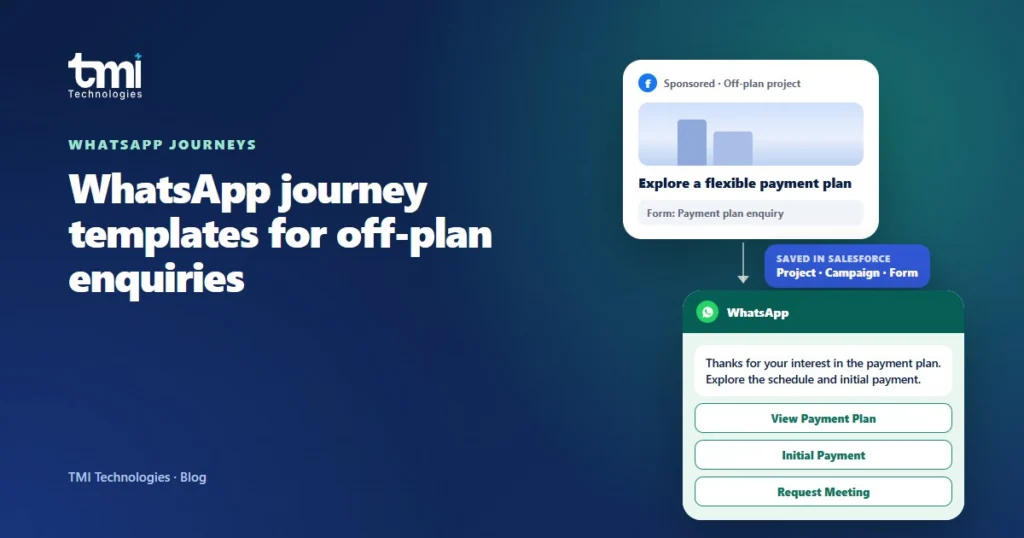
A buyer responds to an ad for a two-bedroom apartment within AED 2 million. Another responds to an ad for a flexible payment plan at the same development. Both submit their details. Both receive the same WhatsApp message asking what they are looking for.
The campaigns have already given the agency a useful starting point. One buyer was drawn to a unit type and price range. The other wanted to understand how payments could be spread. The first WhatsApp response can acknowledge that interest and help each buyer take the next step.
A smarter marketing strategy connects the message to what prompted the enquiry. That starts with carrying the project, campaign and form context into the CRM, where it can guide the conversation.
Start with the project the buyer enquired about
Consider two buyers who submit Facebook forms for different developments. Buyer A enquires about Illustrative Project A. Buyer B enquires about Illustrative Project B. Each should receive the correct project introduction and supporting material.
The welcome message can acknowledge the enquiry, include a short project video and offer useful next actions. The structure can be reused across projects while the name, highlights, video, brochure and payment-plan assets come from the relevant project configuration.
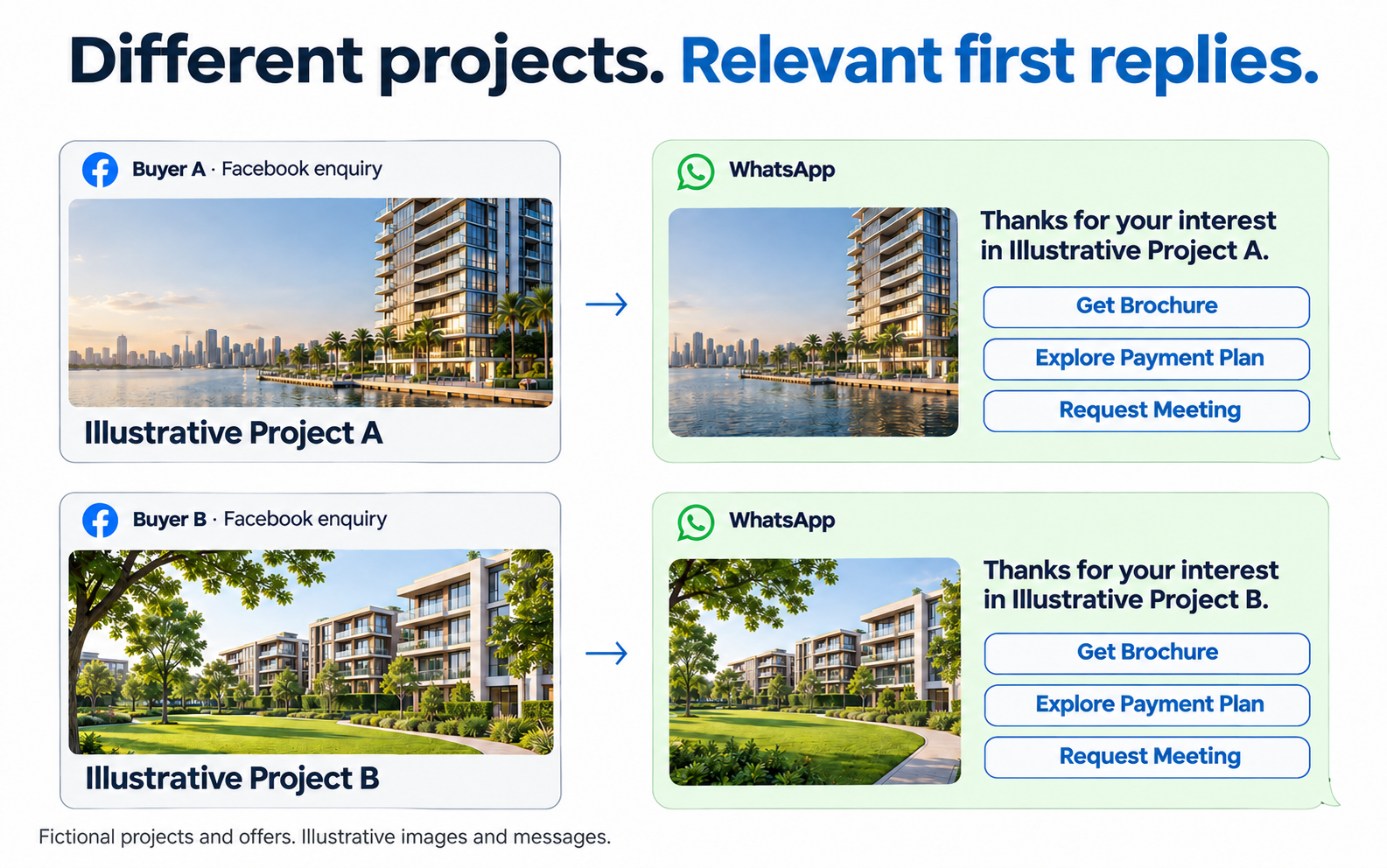
For an initial project enquiry, a useful set of actions is Get Brochure, Explore Payment Plan and Request Meeting. These give an early-stage buyer material to explore and let someone ready to speak reach the project team.
A video welcome can use the video as its media header. The brochure can follow as a separate document message when requested, or be provided through a link. The final format and buttons need to fit the approved WhatsApp template structure.
Then tailor the response to what attracted the buyer
Now keep the project the same and change the campaign. One Facebook ad promotes two-bedroom apartments within AED 2 million. Another promotes a flexible payment plan. Each has its own form.
Both enquiries belong to Illustrative Project A, but they call for different first responses. For the two-bedroom campaign, offer layouts and current availability within the advertised budget. For the payment-plan campaign, offer the payment schedule and initial-payment details.
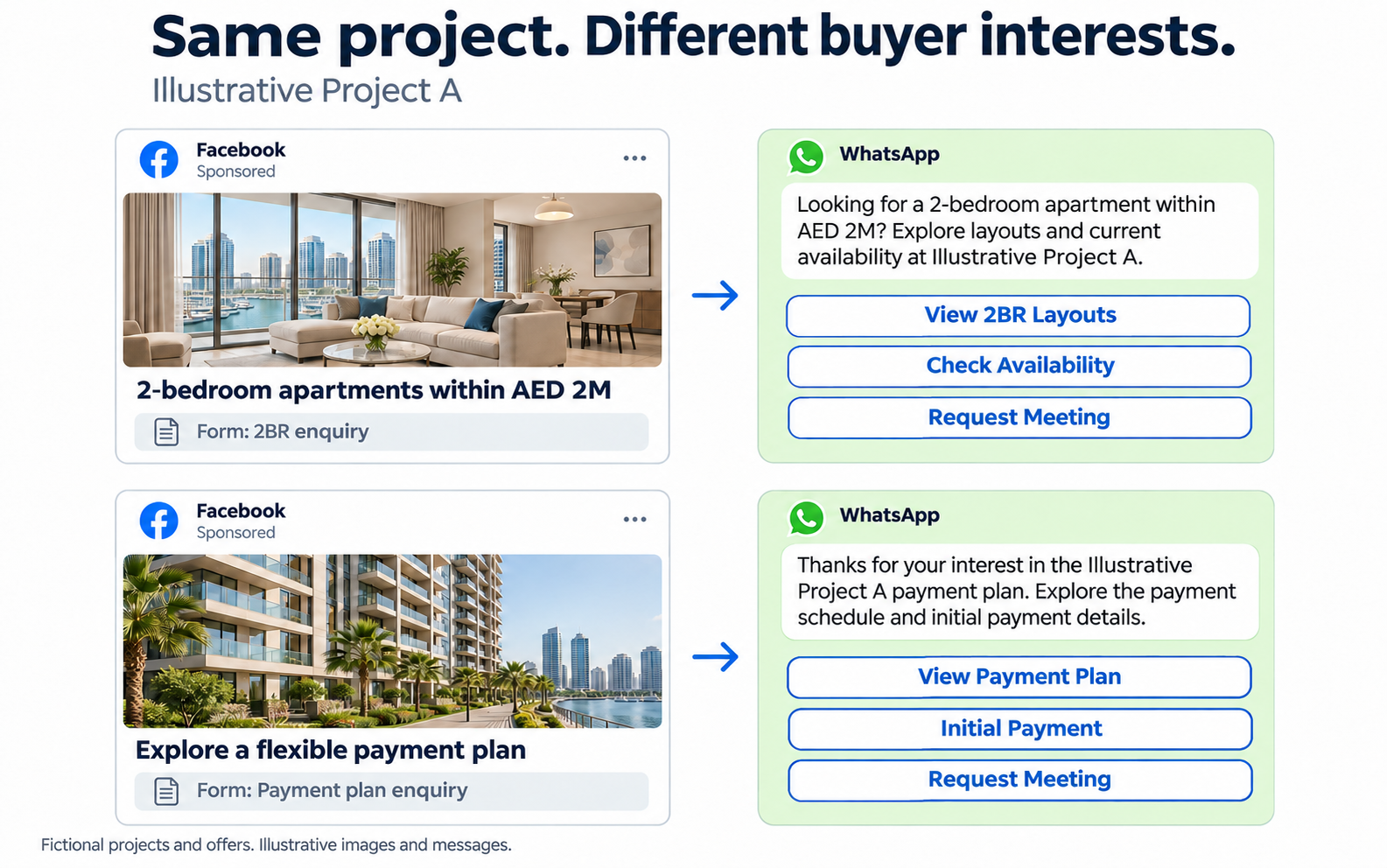
The buttons matter as much as the opening sentence. “View 2BR Layouts” follows naturally from a two-bedroom ad. “View Payment Plan” follows naturally from a payment-plan enquiry. A buyer should be able to act on the interest that brought them to the conversation.
Campaign context is a useful signal of interest. The buyer’s answers and later replies confirm their requirements. Someone attracted by a flexible payment plan may still need to tell the agency their budget, preferred unit type or buying timeline.
| Entry point | What to offer next |
|---|---|
| General project enquiry | Get Brochure · Explore Payment Plan · Request Meeting |
| 2BR within AED 2M | View 2BR Layouts · Check Availability · Request Meeting |
| Flexible payment plan | View Payment Plan · Initial Payment · Request Meeting |
Illustrative example. Project labels, property images, campaign copy and messages are fictional and do not represent an actual development or offer.
Keep the enquiry context all the way into the CRM
“Facebook” as a lead source is a start, but it does not tell the agent what the buyer saw. Preserve the project and campaign detail alongside the contact information, using stable identifiers to map each entry point to the intended journey.
| Detail | What it helps the team do |
|---|---|
| Interested project | Select the correct project assets and eligible sales team. |
| Source and medium | Distinguish Facebook paid social, website traffic and an in-person event. |
| Campaign, ad and form identifiers | Trace the enquiry to the specific message and capture point. |
| Campaign theme | Use an understandable label such as “2BR within AED 2M” in routing and reporting. |
| Submitted answers | Use requirements explicitly shared by the buyer. |
| Enquiry time and relevant history | Understand when the interest arose and what has already happened. |
A website project form can submit its project identifier. A Facebook integration can use ad and form identifiers to resolve the campaign theme. A roadshow can use a dedicated QR code or form for a particular project and event. When one event form covers several developments, ask the visitor which project interests them.
Keep these details against each enquiry. A buyer may enquire about Project A today and Project B next week. Both can link to the same contact, while each retains the project, source and conversation that belong to it.
If the project or campaign mapping is missing, use a clarification step. Asking the buyer to choose a project is better than sending material selected from an uncertain match.
Carry the same context into a project-team meeting
The meeting request is the common next step across the examples. The project identifies the team qualified to handle the conversation. The campaign and submitted answers tell the agent what to prepare.
For a two-bedroom enquiry, the agent can bring relevant layouts and current options. For a payment-plan enquiry, they can prepare the applicable schedule and explain the initial payment. The buyer should not have to repeat the reason they responded to the ad.
Buyer’s request
Request Meeting
- Project
- Illustrative Project A
- Campaign interest
- Flexible payment plan
- Meeting format
- Video consultation
Salesforce scheduling
Find an eligible project specialist
Check current assignment, project coverage and calendar availability. Offer suitable slots with a clear time zone, then recheck the selected time before confirmation.
Define what “the project team’s calendar” means for the agency. The assigned agent may handle the meeting if they cover that project. Otherwise, an available project specialist or shared project calendar may be the appropriate route. Working hours, meeting length and the type of appointment all affect which slots can be offered.
For off-plan enquiries, the appointment might be a video consultation, a sales-gallery meeting or a show-apartment visit. If no suitable slot is available, offer a callback or let the buyer request another time.
After booking, provide confirmation and a way to request changes. Stop generic invitations to book the same meeting, and give the agent access to the enquiry and conversation context.
How to turn the strategy into a system
Start with one project and two distinct campaign themes. Map the campaign and form identifiers, prepare the relevant template wording and actions, and associate each response with the approved project material.
Then define what each action does. A brochure request should return the right document. A payment-plan request should use the applicable approved terms. A meeting request should identify an eligible project specialist and invoke the configured scheduling workflow.
In Salesforce, a WhatsApp automation tool can use the enquiry context to select the configured response and pass the buyer’s action into CRM logic. Project-team routing, document selection and live calendar checks need to reflect the agency’s actual processes and implementation.
Test the whole path from each source, including missing mappings, returning enquiries, reassigned leads and a slot that becomes unavailable before confirmation. Confirm messaging permissions and the applicable template approval and messaging rules before launch.
Measure progression by campaign theme
Compare delivery, replies, layout or brochure requests, payment-plan interest, meetings booked, meetings attended and eventual bookings by project and campaign theme.
A brochure request records interest in receiving material. It does not establish that the buyer read it. Use consistent definitions so marketing and sales can see where the journey progresses and where buyers need a different next step.
Preserve the original campaign attribution while recording later actions. That lets the agency follow a buyer from the ad they responded to through the conversation and the appointment it produced.
Frequently asked questions
Can the same WhatsApp template serve several projects?
A reusable structure can work where the approved wording, variables and media format support the content. Configure the right project values and assets. Changes to wording or buttons may need a separate approved template.
Can different Facebook forms trigger different messages for one project?
Yes, when the integration preserves their identifiers and the CRM maps them to the intended journey. Use explicit mappings and a fallback when the form is unknown.
Does a payment-plan ad tell us the buyer’s full requirements?
It identifies what attracted their attention. Confirm other requirements through submitted answers or the conversation, using short questions when they help the next action.
What happens when the buyer enquires again?
Retain the new enquiry’s context and check the relevant history. A buyer who has already booked a meeting should receive follow-up appropriate to that booking.
Should a brochure be attached to the video welcome?
A standard media-header template uses a selected header format. A video welcome can offer the brochure through a link or a subsequent document response. Check the approved template configuration.