In this article
Your CRM tells you how many enquiries arrived yesterday. Can it help explain which prospects need attention today?
It stores the asking price of a listing. Can it show how that price compares with relevant properties and recent transactions?
It reports how many leads a listing generated. Can it help identify whether weak results come from limited visibility, low engagement, pricing, or follow-up?
These questions describe the next level of value real estate businesses should expect from their CRM.
In this article, Super Intelligence CRM describes a connected CRM that combines customer history, property information, performance data, business rules, and AI to help teams make better decisions and act on them. It is a concept, rather than a standard product category or a claim of general AI superintelligence.
Some capabilities come from AI; others come from analytics, automation, and well-designed processes. Many modern CRMs already support aspects of this approach. The comparison here is with basic CRM usage.
What changes in practice?
| Area | Basic CRM usage | An intelligence-led approach |
|---|---|---|
| Customer follow-up | Stores tasks and reminders | Recommends the next action using the customer journey, engagement, and commitments |
| Listing price | Records the asking price | Adds comparable properties, transaction evidence, and pricing context |
| Listing performance | Counts enquiries | Connects impressions, clicks, CTR, enquiries, qualified conversations, and viewings |
| Listing quality | Stores descriptions and images | Identifies missing information and suggests relevant improvements |
| Lead details | Stores contact information and source | Builds an enriched profile from verified information and interactions |
| Property matching | Filters by budget, location, and bedrooms | Suggests suitable alternatives and explains the fit |
| Lead assignment | Distributes enquiries by rotation | Considers availability, expertise, language, workload, and continuity |
| Customer relationships | Shows transactions | Connects properties, services, referrals, and future requirements |
| Sales reviews | Reports completed activities | Highlights stalled journeys and missed commitments |
| Marketing measurement | Reports cost per lead | Connects acquisition cost with qualification, viewings, deals, and revenue |
From reminders to the next best action
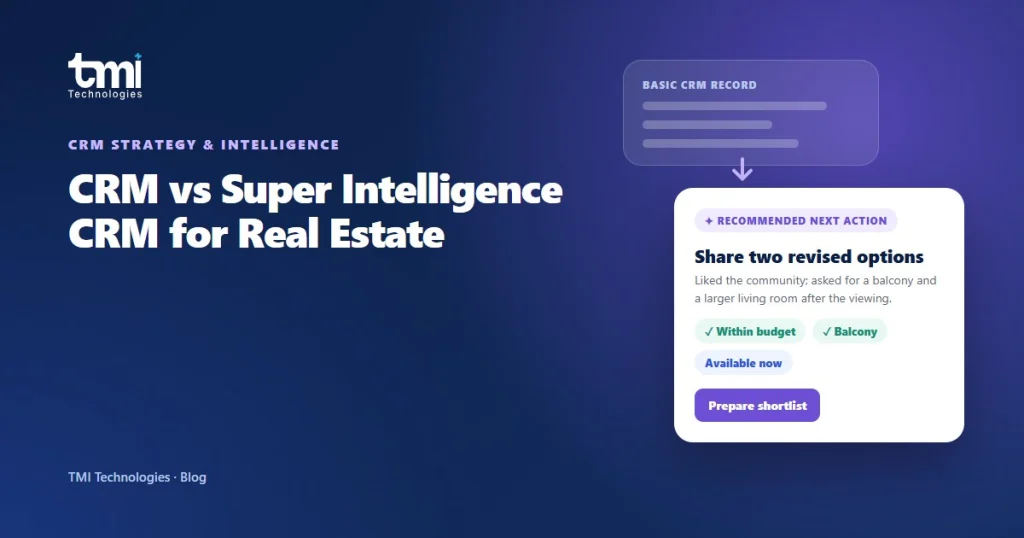
“Follow up tomorrow” is useful, but incomplete. What should the agent discuss? Has the customer already replied on WhatsApp? Did they reject the previous property because of price, layout, or location?
A useful recommendation combines that context: “Share these alternatives. The customer liked the community but rejected the previous unit because it lacked a balcony.”
Explain the reasoning and let the agent act directly. Also recognise when to pause: a customer who asked to reconnect next month should not receive another message simply because a generic workflow is due.
From an asking price to an informed pricing discussion
Relevant pricing evidence may include comparable listings, recent transactions, condition, floor, view, furnishing, size, and availability. Asking prices and completed transaction prices must remain distinguishable, with their source and date.
The CRM could highlight a listing priced above a relevant comparison range that has attracted limited engagement. That prompts a review with the landlord; it does not automatically prove overpricing. Comparables can be incomplete, and distinctive features may justify a premium.
From lead counts to listing performance
A listing generated five enquiries. The result means more when the team also knows how many people saw it, how many clicked, and what happened after the enquiry.
Connect impressions → clicks → enquiries → qualified conversations → viewings → offers → deals. CTR is clicks divided by impressions, expressed as a percentage. Compare consistent periods and account for listing age, property type, and paid promotion.
- Low impressions: investigate publication status, exposure, search demand, and portal quality requirements.
- High impressions but low CTR: review the lead image, headline, visible price, and audience relevance.
- Strong clicks but few enquiries: review the detail page, pricing, missing information, or mismatch with the preview.
These are diagnostic signals, not automatic conclusions. Portal metrics depend on the data access provided by each integration; missing data should remain visible as a gap.
From a basic listing to a listing prepared to perform
A capable CRM can check for missing floor plans, incomplete amenities, inconsistent sizes, stale availability, and weak descriptions. It can help agents prepare clearer content and meet portal-specific verification or quality requirements.
Portal ranking remains subject to each platform’s rules and other factors. A CRM cannot guarantee placement. AI-generated text must not invent a view, parking space, or furnishing status. Virtual staging should be clearly identified and preserve an accurate understanding of the property.
From lead details to an enriched understanding
A name, number, email address, and source create a record. Useful enrichment adds intended use, budget, financing needs, timing, acceptable communities, feedback, preferred communication, and the agreed next action.
Customer-supplied facts should remain distinguishable from inference. Viewing investment properties does not confirm purchase readiness or budget. External enrichment requires authorised sources, provenance, and controls. More fields help only when they improve a relevant decision.
From exact filters to explainable matching
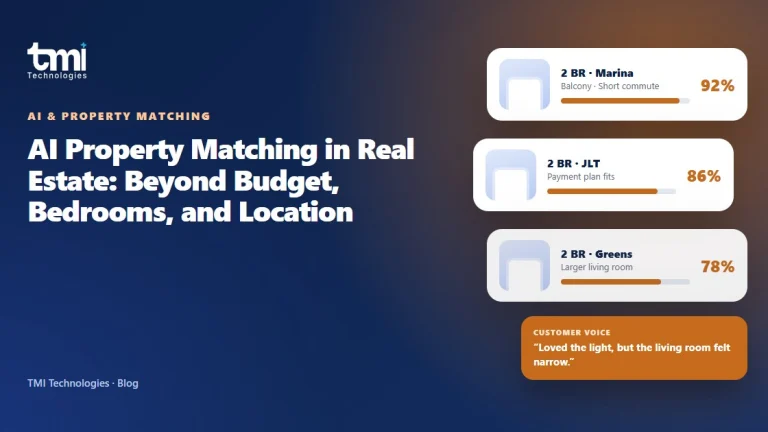
If the original unit is unavailable, understand why it appealed. Was it the commute, balcony, school access, payment plan, or move-in date? Suggest alternatives and explain the trade-offs.
Feedback should improve the next shortlist. If the customer rejects a layout, retain that learning so similar unsuitable units are not repeatedly recommended.
From isolated transactions to Customer 360
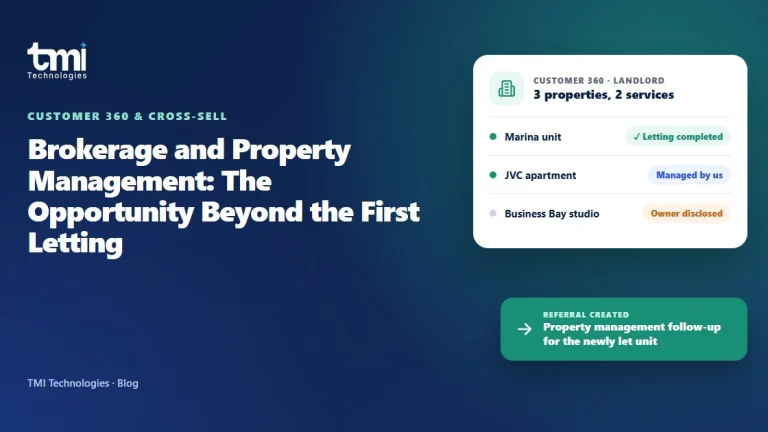
The same landlord may use brokerage, property management, investment services, and referrals over time. Connect the relationship so agents recognise existing services and avoid duplicate approaches.
After a successful letting, a relevant prompt can help the agent explore management support or other properties the customer has disclosed. Track acceptance and outcomes through the handover.
From dashboards to timely intervention
Highlight a qualified prospect with no next action, an unconfirmed viewing, a referral awaiting acceptance, or a deal blocked by missing documents. Managers can then focus on coaching and removing obstacles.
Recommendations need current records, clear ownership, appropriate permissions, and reliable definitions. Show the supporting evidence and retain human review for important decisions. Measure qualified conversations, viewings held, conversion, and time saved alongside the volume of suggestions.
A practical customer journey
After a viewing, recorded feedback identifies why a customer rejected a unit. The CRM suggests alternatives with clear reasons and creates a relevant next action. The agent verifies the shortlist before contacting the customer.
How to turn the strategy into a system
- Choose a decision. Start with one measurable problem such as unsuitable shortlists, unacted enquiries, or weak listing engagement.
- Prepare trusted inputs. Agree definitions, data sources, ownership, refresh frequency, access permissions, and how missing information is shown.
- Connect guidance to action. Configure Salesforce records, rules, analytics, and suitable AI services so users can review the evidence and act from the recommendation.
- Evaluate and improve. Compare recommendation usefulness, process completion, time saved, viewings, and conversion with the previous workflow. Retain correction and approval paths.
Frequently asked questions
What does Super Intelligence CRM mean here?
It describes a CRM approach that turns connected information into explainable guidance and useful actions. It is not a standard product category or a claim that every capability is available out of the box.
Does every improvement require AI?
No. Rules, analytics, automation, and good process design can provide much of the value. Use AI where it improves a defined task.
Can a CRM guarantee better portal rankings?
No. It can help improve completeness, accuracy, and alignment with portal requirements. Placement also depends on platform rules and other factors.
How is CTR calculated?
CTR is clicks divided by impressions, multiplied by 100. Use a consistent reporting period and the portal’s definitions.
What makes lead enrichment useful?
Verified, relevant information that improves a customer decision. Keep source, permission, and certainty visible rather than collecting unnecessary data.
Where should a brokerage begin?
Choose one high-value decision, establish reliable inputs, pilot a usable workflow, and measure business outcomes before adding complexity.
Portal-specific context: Bayut listing quality guidance · Property Finder listing performance metrics. Data availability and requirements vary by portal and integration.